


Talmannen deltog i IPU:s talmanskonferens i Genève
Publicerad:
Talman Andreas Norlén medverkade i den Interparlamentariska unionens sjätte världskonferens för talmän den 29–31 juli i Genève.
Publicerad:
Talman Andreas Norlén medverkade i den Interparlamentariska unionens sjätte världskonferens för talmän den 29–31 juli i Genève.
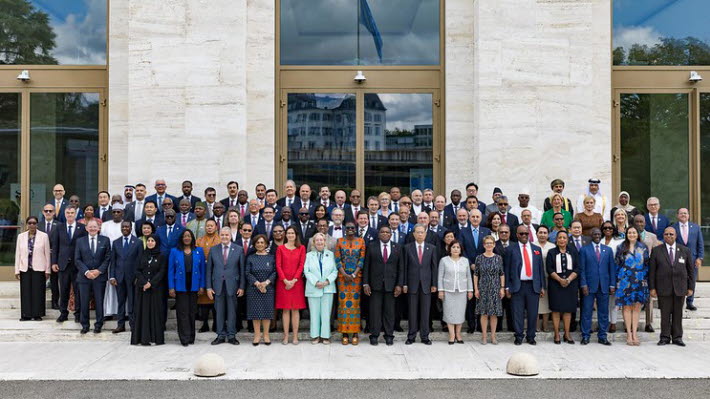
Ett hundratal talmän och ett trettiotal vice talmän deltog i konferensen, som bestod av en generaldebatt, panelsamtal, rundabordssamtal och presentationer av rapporter.
Konferensen ägde rum i en tid präglad av ökande globala spänningar och regionala konflikter. Efter tre dagars debatter och förhandlingar antog talmännen en deklaration som bland annat förespråkar ett fördjupat parlamentariskt engagemang i FN i syfte att uppnå en starkare och effektivare multilateralism.
Talman Andreas Norlén höll ett anförande i plenum samt gjorde inlägg i två paneldebatter. I sitt huvudanförande lyfte talmannen fram sex utmaningar som världen står inför: minskande respekt för internationell lag, propagandakrig som eldas på av desinformation och lögner, handelskrig, stormakter som försöker påtvinga mindre stater sin vilja genom hot och våld samt tillbakagång för demokratin respektive jämställdheten på många håll i världen. Talet finns i sin helhet nedan.
Talmannen hade också möten med representanter för FN-organ som är baserade i Genève, såsom FN:s högkommissarie för mänskliga rättigheter Volker Türk, UNDP:s biträdande generalsekreterare Susan Brown och generaldirektören för Världshälsoorganisationen (WHO) Tedros Adhanom Ghebreyesus. Talmannen hade även bilaterala möten med talmanskollegor från olika länder, till exempel Ukraina, Storbritannien och Sydkorea.
Honourable Chair,
Dear Speakers, Dear Colleagues,
Ladies and gentlemen,
I appreciate this opportunity to meet, especially in these troubled times when all of us, who believe in multilateralism for peace, justice and prosperity, are facing several challenging issues. Let me comment on six of them, which members of the Swedish Parliament are very concerned about. Some of them have already been mentioned by other speakers.
First: Respect for international law is decreasing. There are numerous examples of this, and Russia’s full-scale invasion of Ukraine is certainly one of them. Russia’s war of aggression is a blatant violation of international law, and it is also an attack on democracy and human rights.
International law must be respected in all conflicts, including in the Middle East. Israel naturally has the right to defend itself after the worst mass murder of Jews since the Holocaust, but Israel now has to do more to protect the civilian population in Gaza and greatly increase the access to humanitarian aid. International law, including humanitarian law, must be respected and all violations of international law have to be investigated and those responsible brought to justice.
Second: Apart from the real wars that are waged, there are also several wars of propaganda going on, fuelled by disinformation and lies, not least on social media. Again, Russia’s war against Ukraine can illustrate this. Russia tries to spread its false narratives about the causes of the war, and has been relatively successful in some countries.
Third: Also, trade wars are looming. History has shown that when tariffs rise, there are almost no winners, only losers. Free trade creates growth and innovation, protectionism leads to economic stagnation and growing tensions between countries.
Fourth: Great powers are trying to impose their will on smaller states through threats and violence. Russia is again a clear example, pursuing a 19th century-style imperialistic policy, with the aim of dividing the world between great powers into spheres of influence. Russia’s war against Ukraine aims at destroying Ukraine’s statehood and creating a sphere of influence resembling the borders of the Soviet Union.
Fifth: Democracy is backsliding in many countries. The pattern is often the same. Attacks on the freedom of expression and freedom of the media are followed by attempts to manipulate the electoral system and then by attacks on civil society.
Sixth: Gender equality is also backsliding in many countries. Rather than acknowledging that women’s rights are human rights, work to promote gender equality is being questioned.
But in spite of all these challenges, I remain an optimist. I believe that, eventually, democracy will prevail, because of its inherent strength and the courage and commitment of so many individuals around the world.
Apart from the moral issue, there is also solid support for the notion that democratic societies are better than other societies at delivering growth and wealth to the benefit of all. The laureates of the Nobel Prize in economics in 2024 highlight the connection between democratic institutions and economic development.
But nothing comes automatically. I believe that countries with common values or common interests or both should work closer together. IPU is one important platform. One task is to counter attempts to create a world where great powers call the shots. Another is to support struggling democracies and help them consolidate their institutions, not least their parliaments. IPU provides technical support in this arena.
It is my firm belief that the best way in which we as Speakers of Parliaments can promote multilateralism, peace and international security is to stand up for democracy, human rights and a rules-based world order.
Thank you.
Interparlamentariska unionen IPU, den globala organisationen för världens parlament, består av 181 medlemsländer och 12 regionala parlamentariska organ från hela världen. IPU möts för två stora möten varje år.
Världskonferenser för talmän organiseras i nära samarbete med FN vart femte år och har som uppgift att förstärka den parlamentariska dimensionen av FN:s arbete. Konferenserna äger rum i städer med Förenta nationernas högkvarter (New York, Genève, Wien).