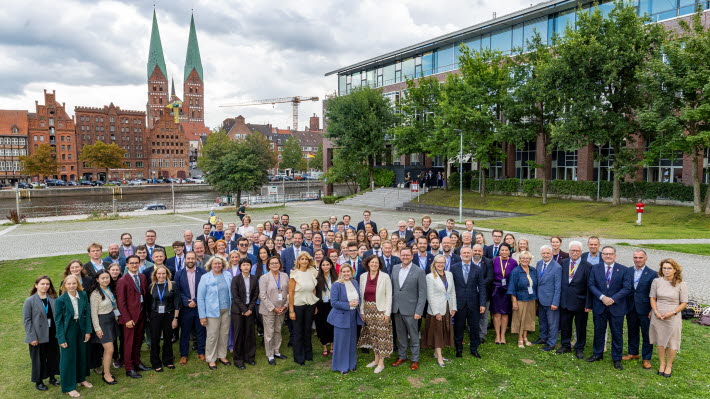
The Baltic Sea Parliamentary Conference is a forum for political dialogue between parliamentarians in the Baltic Sea region and its purpose is to highlight and pursue issues of importance to the region.
Some 60 parliamentarians representing national parliaments, regional parliaments and parliamentary organisations participated in this year’s conference. In addition, it was attended by ministers, government representatives, youth representatives, experts, observers and invited guests from the Baltic Sea region. The Swedish delegation to the Baltic Sea Parliamentary Conference was represented by Staffan Eklöf (Sweden Democrats), Chair, and Hanna Westerén (Social Democratic Party), Deputy Chair.
The meeting was hosted by the state parliament of Schleswig-Holstein, which has held the 2025/2026 presidency of the BSPC.
The Schleswig-Holstein presidency has had a clear focus on young people. A youth forum was held, in which young people from the region drew up a number of recommendations that were presented during the Baltic Sea Conference.
Resolution on youth participation and democratic resilience
In connection with the conference, a consensus resolution was adopted – formed through twelve months of meetings in Kiel, Brussels, Tuku and Neustadt in Holstein. The resolution, a joint statement, with a number of recommendations addressed to member governments, included references to youth participation and intergenerational dialogue, democratic resilience in a time of cyber threats and threats to information and artificial intelligence, as well as security in a sea that is being subjected to ever-increasing pressure.
The resolution is based on the war in Ukraine and highlights for example the risk of escalation and the Russian shadow fleet in the Baltic Sea region. At the same time, emphasis was given to continued support to Ukraine.
The resolution is divided into two main areas: youth participation and democratic resilience.
In the area of democratic resilience, the conference calls for national cyber and information security strategies with a clear Baltic Sea perspective. At the same time, a regional framework is needed that links cybersecurity, protection of critical infrastructure, the fight against disinformation and democratic governance of artificial intelligence.
The resolution is now being passed on to parliaments and governments, to the Council of the Baltic Sea States (CBSS) and to the European Union (EU).
Two-year working group on matters including cyber security
The BSPC has also established a working group that, over a two-year period, will be working with issues regarding the strengthening of cybersecurity and resistance to disinformation to promote democracy, which was one of the themes at the conference.
The Presidency is now moving to Iceland for one year. The programme for the coming year has been entitled “From the Baltic to the Arctic – one democratic space”. The 36th Baltic Sea Parliamentary Conference will be arranged by the Icelandic Parliament – the Althing – in Reykjavík on 29–31 August 2027.
Members
Members of the Swedish BSPC delegation who participated in the Baltic Sea Parliamentary Conference:
Staffan Eklöf (SweDem), Chair
Hanna Westerén (SocDem), Deputy Chair
All the members of the delegation:
Members of the Swedish delegation to the BSPC
More information
The Baltic Sea Parliamentary Conference takes place once a year and gathers parliamentarians from ten national parliaments, seven regional parliaments and five interparliamentary organisations around the Baltic Sea. The first Baltic Sea Parliamentary Conference was held in Helsinki in 1991.
Contact person for the media
Helena Lundstedt, International Adviser, International Department of the Riksdag, , telephone: +46 76 861 95 16, email: helena.lundstedt@riksdagen.se